
TrueCap vs Roofstock: investor services vs your own underwrite
By TrueCap · built by a Philadelphia rental investor
Roofstock's Explore Properties link now opens Stessa's investment-property marketplace, and roofstock.com points individual investors to three brands: Mynd for property management, Stessa for landlord software and RentPrep for tenant screening. TrueCap is a separate calculator: it does not sell or certify a property, but it lets you model a potential acquisition using assumptions you can inspect and replace. Confirm Roofstock's current service and transaction terms directly.
Free analyzer: no card or signup
TL;DR
Use TrueCap when
- You want your own underwrite of a listing you found on Stessa's marketplace, where Roofstock now sends buyers.
- You want to run a marketplace listing and a deal from anywhere else through the same model.
- You want to replace third-party assumptions with property-specific evidence and test a range.
- You want a 10-year cash-flow and equity projection (Pro).
- You want a Deal score with a transparent breakdown.
Use Roofstock when
- You want to browse listings with investor metrics: its Explore Properties link opens Stessa's marketplace.
- You want a vetted local agent to help negotiate, inspect and close.
- You want full-service property management (Mynd) or tenant screening (RentPrep).
- You have independently verified the property-specific financial assumptions.
Treat any seller, marketplace, manager, or calculator pro forma as a model rather than a promise. Verify the evidence behind rent, taxes, insurance, financing, vacancy, management, maintenance, and capital reserves, then sensitivity-test the assumptions before deciding.
Feature-by-feature
TrueCap provides an underwriting model. The Roofstock column is what roofstock.com, Stessa's marketplace pages and Stessa's help center said in October 2026; confirm current details on those sites.
| Feature | TrueCap | Roofstock |
|---|---|---|
| Primary purpose | Per-deal underwriting calculator | Services for residential investors: listings on Stessa's marketplace, Mynd for property management, RentPrep for tenant screening |
| Cost to use | Free core and paid Pro — see live pricing | Marketplace listings can be browsed without an account; see Stessa, Mynd and RentPrep for each service's pricing |
| Underwriting perspective | Separate model using editable assumptions | Stessa's marketplace projects rent and returns from its own inputs, which you can replace |
| Cap rate / CoC / DSCR | Calculated from the assumptions entered | Gross yield, cap rate and cash on cash on marketplace listing cards |
| Editable assumptions | Rent, vacancy, management, reserves, taxes, financing, and more | Offer price, financing, rent and operating costs in the marketplace calculator |
| 10-year projection | Pro — rent, expense, appreciation, and equity scenarios | The marketplace calculator is a year-1 pro-forma: cash flow, cap rate and cash on cash |
| Sensitivity grid (stress test) | Pro — rent ±10%, vacancy ±5pp, rate ±1pp | Stessa's Stress Test report models rent collection scenarios against cash reserves for properties you already own |
| Deal score with breakdown | Free — 0–100 score with subscore drill-down | A 1-to-5 neighborhood score on each listing, Roofstock's own rating |
| Starting data sources | Editable HUD rent and FRED rate benchmarks; manual local property tax | Stessa's rent estimates and comps, with default property tax, insurance and HOA estimates |
| Transaction services | No — analysis only | The marketplace connects you with a vetted local agent who helps negotiate, inspect and close |
| Property discovery | No inventory; analyze a supported address or enter inputs manually | Listings on Stessa's marketplace, with buy box filters and alerts |
| Property management connection | Not included | Mynd, Roofstock's full-service property management brand |
| Property coverage | Supported U.S. addresses with manual input fallback | Listings across the U.S., per Stessa's help center |
| Shareable read-only deal link | Free read-only public link; Pro adds co-branding | See Stessa's marketplace for what a listing lets you share |
| PDF report export | Included with Pro | See Stessa's marketplace for its report options |
| Mobile-first UX | PWA — install to home screen | Stessa has iOS and Android apps |
Roofstock details are from Roofstock's official individual-investor page, Stessa's marketplace, its marketplace overview, Stessa's help center and Stessa's Stress Test article, read in October 2026.
How to review a property with your own assumptions
- Copy the listing address into the TrueCap analyzer. TrueCap starts with editable HUD rent and FRED rate benchmarks; property tax stays manual. They are starting assumptions, not property-specific quotes or guarantees.
- Replace rent with property-specific evidence. Compare current local comps, executed leases where available, concessions, condition, and seasonality. Test a range rather than using a universal percentage threshold.
- Use property- and market-specific expense evidence. Obtain current tax, insurance, management, maintenance, leasing, utility, and capital-reserve estimates, then model a reasonable range.
- Run the sensitivity grid (free on your first decision). See how the deal changes across lower-rent, higher-vacancy and higher-rate scenarios. The grid is decision support, not a forecast.
- Review the Deal score and its inputs. It is a heuristic summary of the modeled numbers, 0–100. Apply your own criteria and complete diligence.
Want a faster read on a marketplace listing? The free gross rent multiplier calculator triages one in seconds, and when the listing survives that screen the full TrueCap analyzer computes cap rate and cash-on-cash return from an address, the asking price and a bedroom count. For the full workflow, our guide on 60-second underwriting walks through exactly the steps above.
Common questions about TrueCap vs Roofstock
Quick answers to the questions investors comparison-shopping these tools actually ask.
Is TrueCap a Roofstock alternative?
Not directly. They solve different problems. Roofstock offers services for residential investors: property listings through Stessa's marketplace, property management through Mynd and tenant screening through RentPrep. TrueCap is a separate calculator for supported properties and manually entered assumptions. The tools may complement each other, but neither replaces property-specific diligence.
Are Roofstock listings actually good deals?
That cannot be determined from the platform name. Review the property, agreement, current service terms, rent evidence, taxes, insurance, financing, vacancy, management, maintenance, reserves, title, inspection, and local rules. Sensitivity-test a range; TrueCap does not certify a property as a good or bad investment.
What is Roofstock's fee compared to using TrueCap?
Roofstock's offering and transaction terms can change, so use the relevant agreement and official site for the current fees. TrueCap has a free core analyzer plus paid Pro; new one-time PDF purchases are temporarily unavailable. Its live pricing page is the source of truth.
Can TrueCap analyze any Roofstock listing?
Roofstock's listings now open on Stessa's marketplace. For supported U.S. addresses, paste the address into TrueCap. If lookup data is unavailable, enter the property inputs manually. HUD rent and FRED rate are editable screening benchmarks; property tax is a manual local input. Replace them with property-specific evidence.
Should I trust the Roofstock pro-forma cap rate?
Stessa's marketplace, which Roofstock powers, shows a cap rate on its listing cards, and its calculator starts from default estimates for property taxes, insurance and HOA fees. Recalculate it from the documented inputs. Confirm how income, vacancy, taxes, insurance, management, maintenance, utilities, and reserves are defined, then replace them with current evidence and test a range. TrueCap's result is also only as reliable as the assumptions entered.
When should I skip Roofstock and find deals elsewhere?
Compare Roofstock's current service, property availability, agreements, fees, diligence materials, providers, and support with direct sourcing and other alternatives. Choose based on the specific transaction and your ability to complete local, legal, financial, and physical diligence.
On price, plainly
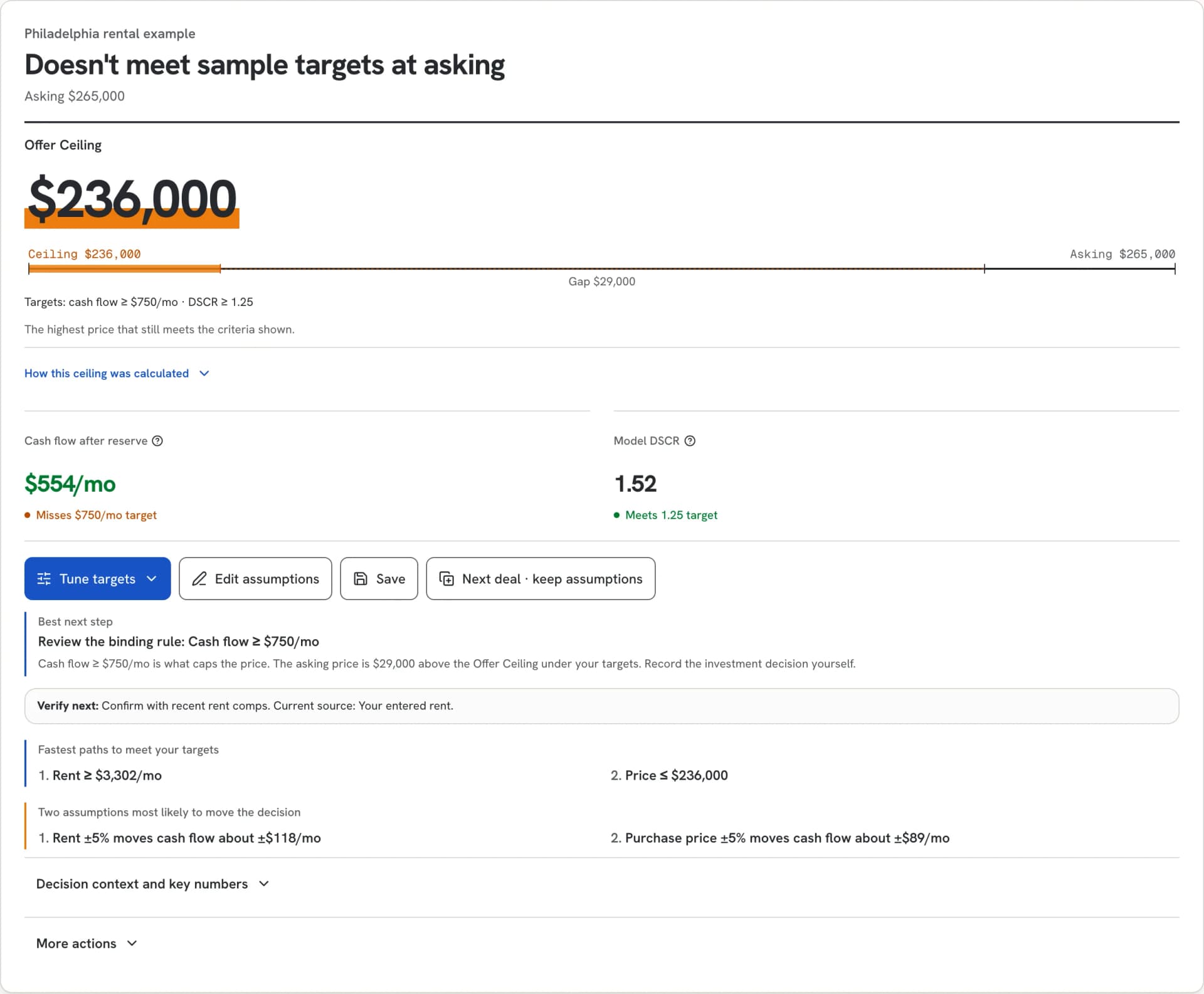
Tools in this space run from free to well above TrueCap — check Roofstock's live pricing for their current number. What TrueCap's price buys is the decision layer, not more calculation: an Offer Ceiling for your targets, Buy Box fit with reasons, the downside stress test, and assumptions that are source-labeled instead of silently defaulted. Whether that workflow justifies the price depends on your volume, verification process, and existing tools.
Screening listings for investor clients? TrueCap for agents keeps a client roster and screens each deal against the Buy Box of the client you assign it to.
Underwrite the next listing on your own assumptions.
Free covers the core underwrite and plain read-only share links. Your first complete decision also includes the Offer Ceiling. Pro adds 10-year cash-flow and equity projections, sensitivity, Offer Ceiling, co-branding, and included PDFs. New one-time PDF purchases are temporarily unavailable. No card to start.
About TrueCap
TrueCap is built by one person, a rental investor in Philadelphia. It started as the tool he wanted for his own underwriting — a way to get from an address to a source-labeled first-pass answer — and it's still how he runs the deals he considers.