
TrueCap vs Stessa: two acquisition workflows, different depth.
By TrueCap · built by a Philadelphia rental investor
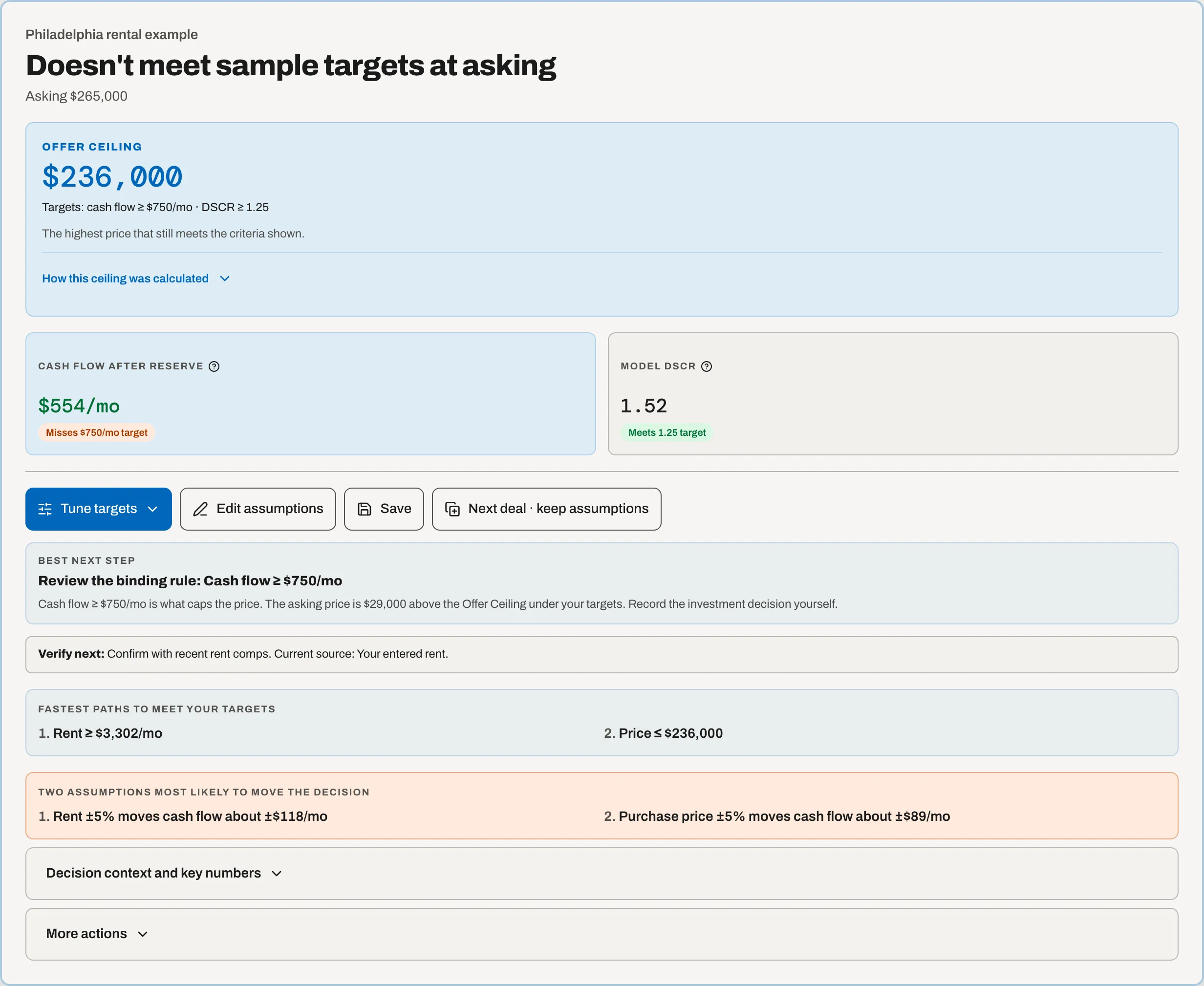
Stessa now spans acquisition through owned-property operations: its marketplace includes discovery, buy boxes, comps, and editable underwriting. TrueCap stays focused on a source-labeled acquisition decision and the Offer Ceiling: the highest price that still meets your targets.
Reviewed October 2026 against the official sources linked below.
Free analyzer: no card or signup
TL;DR
Pick TrueCap if
- You already find listings elsewhere and want a focused acquisition review.
- You want each starting benchmark labeled and editable.
- You want Buy Box fit and an Offer Ceiling.
- You want downside testing and a shareable decision record.
Pick Stessa if
- You want to discover listings with investor filters and buy-box alerts.
- You want projected rent, comps, and underwriting in that marketplace.
- You want bank-connected automatic transaction tracking.
- You want rent collection, leasing tools, and tax-time reports in the same broader product.
Our take: the products overlap during acquisition. Stessa is no longer accurately described as post-purchase only. The meaningful comparison is focused decision workflow versus a broader search-to-operations platform; using both is optional, not the default answer.
Feature-by-feature
Note: green check ≠ "better" — it means "this is what the tool is built for."
| Feature | TrueCap | Stessa |
|---|---|---|
| Product scope | Focused acquisition screening, target review, and decision records | Acquisition marketplace and underwriting plus accounting and landlord operations |
| Listing discovery | No marketplace; analyze an address or listing you bring | Marketplace with investor filters, map layers, watchlists, and buy-box alerts |
| Pre-purchase analysis | Cash flow, cap rate, CoC, DSCR, editable assumptions, and paid advanced views | Listing-level rent and sale comps plus editable offer, financing, rent, and operating-cost assumptions |
| Public returns calculator | No-account core rental analyzer | Purchase, debt, rent, expense, DSCR, depreciation, and after-tax outputs |
| Offer Ceiling | Pro — the highest price that still meets your targets | The reviewed official sources describe custom offer-price scenarios, not an Offer Ceiling |
| Downside sensitivity | Pro acquisition grid for rent, vacancy, and rate changes | Owned-portfolio Stress Test varies rent collection and expenses against cash reserves; marketplace assumptions are also editable |
| Acquisition data context | Editable HUD rent and FRED rate benchmarks; manual local property tax | Projected rent, public-record tax, insurance estimate, sale/rent comps, and neighborhood metrics |
| Longer-range pro forma | Pro includes a modeled 10-year view | Current Pro pricing publishes budgeting and pro-forma; the reviewed page does not specify a horizon |
| Owned-property accounting | No bank-feed accounting | Automatic bank feeds, transaction tracking, and financial reports |
| Tax-time reporting | No tax-specific module offered right now | Schedule E report is listed on current Manage and Pro plans |
| Rent collection and leasing | No | Rent collection, tenant screening, maintenance, forms, and plan-dependent eSignatures |
| Document storage | Due-diligence checklist and document vault on saved deals (a free account saves up to 5) | Unlimited document storage is listed across current plans |
Sources reviewed October 2026:
- Stessa Investment Property Marketplace
- Marketplace help article
- Investment Property Metrics FAQ
- Stress Test / Sensitivity Analysis Report
- Rental Property Returns and Income Tax Calculator
- Stessa pricing
Features and plan placement can change; verify the current product before buying.
The actual recommendation
Choose TrueCap when you bring your own listings and want a focused, source-labeled acquisition review with an Offer Ceiling.
Evaluate Stessa when you want listing discovery, buy-box alerts, comps, and underwriting connected to ongoing accounting and landlord operations.
If you already use Stessa, test its current acquisition workflow against your needs before adding another analyzer. If you prefer TrueCap for acquisition, Stessa can still receive the property after closing for actuals.
For acquisition specifically, the highest-leverage TrueCap pages are the walkthroughs on how to calculate cap rate and how to calculate DSCR, which take the math end to end before you commit to a full underwrite, plus the longer-form guides on 60-second underwriting and rental property tax deductions (the operations side that overlaps with what Stessa tracks).
Common questions about TrueCap vs Stessa
Quick answers to the questions investors comparison-shopping these tools actually ask.
Is Stessa the same kind of tool as TrueCap?
They overlap, but their scope differs. Stessa's investment-property marketplace supports listing discovery, buy boxes, comps, and editable acquisition underwriting, then Stessa continues into accounting and landlord operations. TrueCap is narrower: a source-labeled acquisition decision workflow built around your targets.
Should I use Stessa or TrueCap?
Choose based on workflow. TrueCap fits investors who source listings elsewhere and want a focused target, sensitivity, and decision-record workflow. Stessa fits investors who want marketplace discovery and acquisition analysis connected to accounting and operations. Some investors may use both, but neither pairing nor a strict before/after split should be assumed.
Is Stessa free?
Stessa currently publishes a free Essentials tier plus paid Manage and Pro tiers with different feature sets. Its current pricing places the Schedule E report on Manage and Pro, while Essentials includes basic financial reports. Check both live pricing pages for current rates, marketplace access, and plan terms.
Does TrueCap track expenses like Stessa?
No. TrueCap models projected expenses for underwriting (taxes, insurance, vacancy, management, maintenance, and reserves), but it does not connect to a bank or treat projected values as actuals. Stessa provides those accounting and operations workflows.
Can I share a TrueCap analysis with my accountant?
Yes — every TrueCap user can generate a public read-only share link for free; Pro adds co-branding and includes the multi-page PDF. Reports reflect the analysis fields available for that deal and can support an accountant's independent review.
On price, plainly
Tools in this space run from free to well above TrueCap — check Stessa's live pricing for their current number. What TrueCap's price buys is the decision layer, not more calculation: an Offer Ceiling for your targets, Buy Box fit with reasons, the downside stress test, and assumptions that are source-labeled instead of silently defaulted. Whether that workflow justifies the price depends on your volume, verification process, and existing tools.
Screening listings for investor clients? TrueCap for agents keeps a client roster and screens each deal against the Buy Box of the client you assign it to.
Underwriting the next deal? Start free.
TrueCap free covers cap rate, CoC, model DSCR, monthly cash flow, up to five saves, read-only share links, and the due-diligence checklist/document vault. Your first complete decision also includes the Offer Ceiling. Pro adds sensitivity, the Offer Ceiling, 10-year projections, focused comparison, Buy Box screening, co-branding, and PDF reports. See live pricing for current terms.
About TrueCap
TrueCap is built by one person, a rental investor in Philadelphia. It started as the tool he wanted for his own underwriting — a way to get from an address to a source-labeled first-pass answer — and it's still how he runs the deals he considers.