
TrueCap vs Mashvisor: per-deal math vs market data.
By TrueCap · built by a Philadelphia rental investor
Mashvisor is built around market-level data — heatmaps, ZIP-code Airbnb occupancy, comps. TrueCap is built around per-deal math — should I actually buy this specific property? Here's when to pick which.
Free analyzer: no card or signup
TL;DR
Pick TrueCap if
- You've found a specific property and need to decide if it pencils.
- You want free core cap rate, CoC, DSCR, and cash-flow analysis.
- You want stress-test sensitivity and a 10-year cash-flow and equity planning view.
- You prefer labeled HUD rent and FRED rate benchmarks plus an explicit manual local tax input.
- You don't need market-level data and want the per-deal math free.
Pick Mashvisor if
- You're still deciding WHICH market to invest in (heatmaps help).
- You're running an STR strategy and need Airbnb occupancy data.
- You want rental comps built in (Standard and above).
- You want to browse investment-property listings.
Feature-by-feature
Where each tool earns its keep.
| Feature | TrueCap | Mashvisor |
|---|---|---|
| Primary job | Per-deal underwriting — does this property fit my Buy Box? | Market and property research: where to invest, and which listing |
| Free tier depth | Core cap rate, CoC, DSCR, cash flow and the Deal score; Buy Box fit on the first decision, then with Pro | No free plan on its pricing page; platform subscriptions have no free trial |
| Per-deal cap rate / CoC / DSCR | Yes — live as you type, with inline benchmarks | Cap rate, cash-on-cash and cash flow estimates per property; editable expenses on Standard and above; DSCR not listed |
| 10-year projection | Pro — 10-year cash flow and equity projection | Not listed on Mashvisor's plan comparison |
| Market-level heatmaps | No — focused on the property in front of you | Yes, on Standard and above: listing price, rental income, cash-on-cash return and Airbnb occupancy by neighborhood |
| Airbnb / STR market data | No Airbnb market data. A beta short-term rental revenue screen works from the nightly rate and occupancy you enter | Yes: Airbnb occupancy, nightly rate and revenue estimates by address or market |
| Sale + rent comps | One free lookup with an account; Pro and Agent Pro include up to 50 per month; each returns sale and rent comps with a value estimate and a rent estimate | Rental comps on Standard and above; comparable sales feed its investment scores |
| Property listings discovery | Not the focus — start with an address you found elsewhere | Yes: nationwide property search on every plan |
| Sensitivity / stress test | Pro — rent ±10%, vacancy ±5pp, rates ±1pp | Not listed on Mashvisor's plan comparison; expenses can be edited and recalculated on Standard and above |
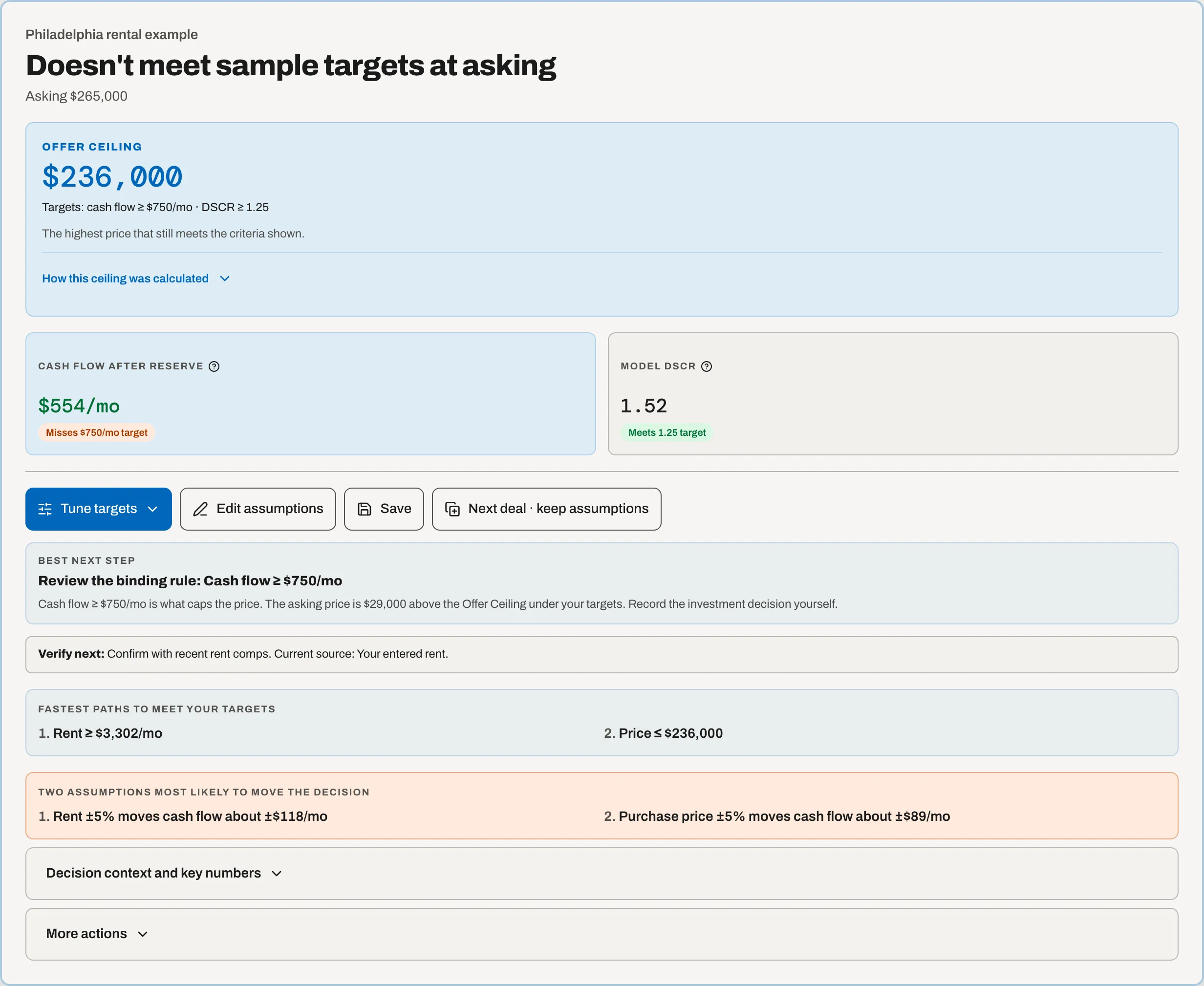
| Offer Ceiling solver | Pro — works backward from your targets | Not listed on Mashvisor's plan comparison |
| Deal score + breakdown | Free — 0–100 score with per-subscore explanation | Its own Investment Opportunity Score per property |
| Free starting values | HUD rent + FRED rate + manual property tax — free, no signup | Requires an account; platform plans are paid, with no free trial |
| Sharable read-only deal links | Free — read-only public link; Pro adds co-branding | Not listed on Mashvisor's plan comparison |
| PDF deal report | Included with Pro | Professional plan only |
| Pricing | Free + monthly Pro on /pricing, no card to start | Lite, Standard and Professional run $39.99 to $99.99 a month billed annually, or $49.99 to $119.99 billed quarterly; Enterprise is priced on request (as of October 2026) |
Mashvisor plans, prices and features were checked against its pricing page in October 2026. See mashvisor.com/pricing for current terms.
Where each one stops
Mashvisor is built for market research and STR-focused strategies, and it estimates cap rate, cash-on-cash return and cash flow for a property. Its plan comparison does not list DSCR, a stress test, or a price solved from your own targets: heatmaps tell you which neighborhood; they don't tell you whether THIS specific 3-bed off Market St clears your DSCR target with the lender you're actually talking to.
TrueCap is built for the moment you have an address and need to decide. Free analyzer, no signup wall, real depth on the Pro tier. For long-term rentals especially, the per-deal math is what determines whether you're making money — the heatmaps just told you to look.
Once the heatmap points you somewhere, the per-deal math takes an address, the asking price and a bedroom count: our free deal analyzer returns cap rate, cash-on-cash return, and DSCR on the first screen. Our walkthrough on underwriting a rental in 60 seconds shows the full move from listing to a reviewed underwrite.
Common questions about TrueCap vs Mashvisor
Quick answers to the questions investors comparison-shopping these tools actually ask.
Is TrueCap a Mashvisor alternative?
Yes, but they solve different problems. Mashvisor is built for market discovery — heatmaps, neighborhood scoring, Airbnb comps. TrueCap is built for per-property underwriting — once you have an address, decide if the deal works. The two can be used in turn: Mashvisor to find a neighborhood, TrueCap to underwrite the specific listing.
How does TrueCap compare to Mashvisor for short-term rentals?
Mashvisor has Airbnb occupancy and nightly-rate data built in; TrueCap does not. TrueCap is built around the long-term rental underwrite: DSCR, sensitivity, and an Offer Ceiling for your targets. If STR is your primary strategy, Mashvisor supplies the market data; TrueCap's short-term rental mode is a beta revenue screen that works from the nightly rate and occupancy you enter. If you're long-term buy and hold, TrueCap covers the per-deal underwrite.
Is Mashvisor or TrueCap cheaper?
The products have different scopes and changing plan terms. TrueCap has a free core analyzer plus paid Pro; new one-time PDF purchases are temporarily unavailable. Mashvisor publishes tiered market-data plans. Compare both official pricing pages for the features and current rates you need.
Does TrueCap have neighborhood heatmaps like Mashvisor?
No. TrueCap is explicitly not a market-discovery tool — we don't do heatmaps, neighborhood scoring, or nationwide-comparables. If you need that, use Mashvisor or AirDNA. TrueCap's job is to take an address you've already chosen and underwrite the specific property.
Can I use TrueCap to analyze deals in any US market?
Yes. TrueCap pulls a HUD rent benchmark (ZIP-level when available, otherwise the HUD Fair Market Rent area; when an address has no county match, a statewide HUD figure, labeled as such) and the FRED 30-year mortgage rate (national). Property tax remains a manual local input with a disclosed generic default when blank. These are screening assumptions—not a property rent quote, mortgage offer, or parcel tax verification—so users should replace them with deal-specific evidence. The per-deal underwriting math itself is market-agnostic.
On price, plainly
Tools in this space run from free to well above TrueCap — check Mashvisor's live pricing for their current number. What TrueCap's price buys is the decision layer, not more calculation: an Offer Ceiling for your targets, Buy Box fit with reasons, the downside stress test, and assumptions that are source-labeled instead of silently defaulted. Whether that workflow justifies the price depends on your volume, verification process, and existing tools.
Screening listings for investor clients? TrueCap for agents keeps a client roster and screens each deal against the Buy Box of the client you assign it to.
Underwriting the next deal? Start free.
TrueCap free covers cap rate, CoC, DSCR, monthly cash flow, and plain read-only share links. Your first complete decision also includes the Offer Ceiling. Pro adds co-branding, 10-year cash-flow and equity projections, sensitivity, Offer Ceiling, saved-deal comparison, and included PDFs. No card to start.
About TrueCap
TrueCap is built by one person, a rental investor in Philadelphia. It started as the tool he wanted for his own underwriting — a way to get from an address to a source-labeled first-pass answer — and it's still how he runs the deals he considers.