
TrueCap vs Avail: underwrite the deal, then run the rental
By TrueCap · built by a Philadelphia rental investor
Avail is the DIY-landlord stack: list the unit, screen tenants, sign a state-specific lease, collect rent online, handle maintenance. TrueCap models whether the reviewed assumptions produce cash flow. TrueCap fits due diligence; Avail fits what comes after closing.
Free analyzer: no card or signup
TL;DR
Use TrueCap for
- Underwriting before you make an offer.
- Comparing 2–3 deals you're seriously considering.
- 10-year cash flow + appreciation projection.
- Stress-testing rent, vacancy, and rate assumptions.
- Generating a shareable read-only deal analysis for partners or lenders.
Use Avail for
- Listing a vacant unit across major rental sites.
- Online rental applications + TransUnion-powered screening.
- State-specific lease templates with online signing.
- Online rent collection (tenants pay $2.50 per bank transfer on the free plan; no fee on Unlimited Plus).
- Tenant maintenance requests + ongoing ops.
One way to think about it: TrueCap is the diligence tool you use during the LOI / inspection period. Avail is the operations stack you set up the week after you close.
Feature-by-feature
Most rows show clear specialization — TrueCap for underwrite, Avail for ops. Where both have something, the difference is usually scope.
| Feature | TrueCap | Avail |
|---|---|---|
| Lifecycle stage | Pre-purchase — underwrite the deal | Post-purchase — operate the property |
| Cap rate / CoC / DSCR analysis | Yes — full engine, free tier | Avail publishes a rental property calculator (cap rate, cash-on-cash, debt coverage ratio, IRR, GRM) |
| Cash flow projection | Pro — 10-year with rent + expense + appreciation | Its calculator lists monthly income and IRR as outputs and takes a growth-rate input; no year-by-year projection is listed |
| Sensitivity grid | Pro — rent ±10%, vacancy ±5pp, rate ±1pp | No sensitivity output is listed; you change the inputs and re-run |
| Deal score (0–100) | Free — 0–100 score with factor breakdown | Not applicable |
| Rental listing distribution | No | Yes: syndicated to Realtor.com, Redfin, Zumper and other sites (19 in total, per Avail) |
| Online rental application | No | Yes: standard application on the free plan; custom questions on Unlimited Plus |
| Tenant screening (credit/criminal) | No | Yes — TransUnion-powered |
| Online lease signing | No | Yes — state-specific lease templates |
| Online rent collection | No | Yes: bank transfer and card; on the free plan tenants pay $2.50 per bank transfer, waived on Unlimited Plus |
| Maintenance request workflow | No | Yes — tenant portal |
| Pricing (entry tier) | Free for underwriting | Free Unlimited plan; Unlimited Plus $9 per unit per month (as of October 2026) |
| Free tier covers core job | Yes — core cap rate, CoC, DSCR, and cash flow | Yes: listings, state-specific leases, online rent collection |
| Starting values (rent, rate, tax) | HUD rent + FRED rate + manual local property tax | Its calculator tries to pull in some data from the address |
| Multi-property dashboard | Yes — portfolio rollup of saved deals | Yes: unlimited units on one account |
| Owned by Realtor.com | No (independent) | Yes (since 2020) |
Avail details checked against avail.com's pricing, rental listings, and rental property calculator pages in October 2026. See Avail's pricing page for current plans.
The DIY landlord workflow: TrueCap + Avail
- Source the deal (Zillow, MLS, wholesaler, off-market).
- Underwrite in TrueCap. Paste the address; a HUD rent benchmark and the FRED owner-occupied rate can pre-fill; property tax remains a manual local input. Check cap rate, CoC, DSCR, monthly cash flow against benchmarks. Sensitize the inputs. Save the deal.
- Verify the material inputs and record your decision. If you proceed, the transaction and closing workflow happens outside TrueCap.
- Set up the property in Avail. List vacant units, accept online applications, screen tenants with TransUnion, sign a state-specific lease online.
- Collect rent + handle ops in Avail. Rent collection is included; on the free plan the tenant pays $2.50 per bank transfer. Tenants submit maintenance requests through the portal.
- Annual review back in TrueCap. Re-run the underwrite with actuals from Avail to see how the property is performing vs the original projection — and feed that learning into the next acquisition.
Want to start with just the underwrite? Two free screens — the 1% rule calculator and the gross rent multiplier calculator — size up a listing in seconds, and the full TrueCap analyzer computes cap rate, cash-on-cash, and DSCR from an address, the asking price and a bedroom count. Our guide on 60-second underwriting walks through exactly what to do.
Common questions about TrueCap vs Avail
Quick answers to the questions investors comparison-shopping these tools actually ask.
Is TrueCap an Avail alternative?
No — they cover different stages. Avail is post-purchase landlord operations: listing, screening, leases, rent collection, maintenance. TrueCap is pre-purchase underwriting: cap rate, CoC, DSCR, projection, Deal score. The two cover different stages and can be used together.
Can TrueCap do what Avail's listing or screening does?
No. TrueCap doesn't distribute listings, run credit reports, or store rental applications. Those are FCRA-regulated workflows we don't build. Avail (and similar tools) are the right place for that. TrueCap is explicitly the pre-purchase underwriting layer.
Is Avail free? Is TrueCap?
Avail's "Unlimited" plan is free for landlords and includes listings, lease signing, and online rent collection; on that plan tenants pay $2.50 per bank transfer. "Unlimited Plus" is $9 per unit per month (as of October 2026) and waives the bank-transfer fee. TrueCap is free for core underwriting math; Pro adds 10-year cash-flow and equity projections, sensitivity, co-branded share links, and included PDFs. New one-time PDF checkout is temporarily unavailable; see TrueCap's live pricing page for current terms.
Does Avail's calculator replace TrueCap?
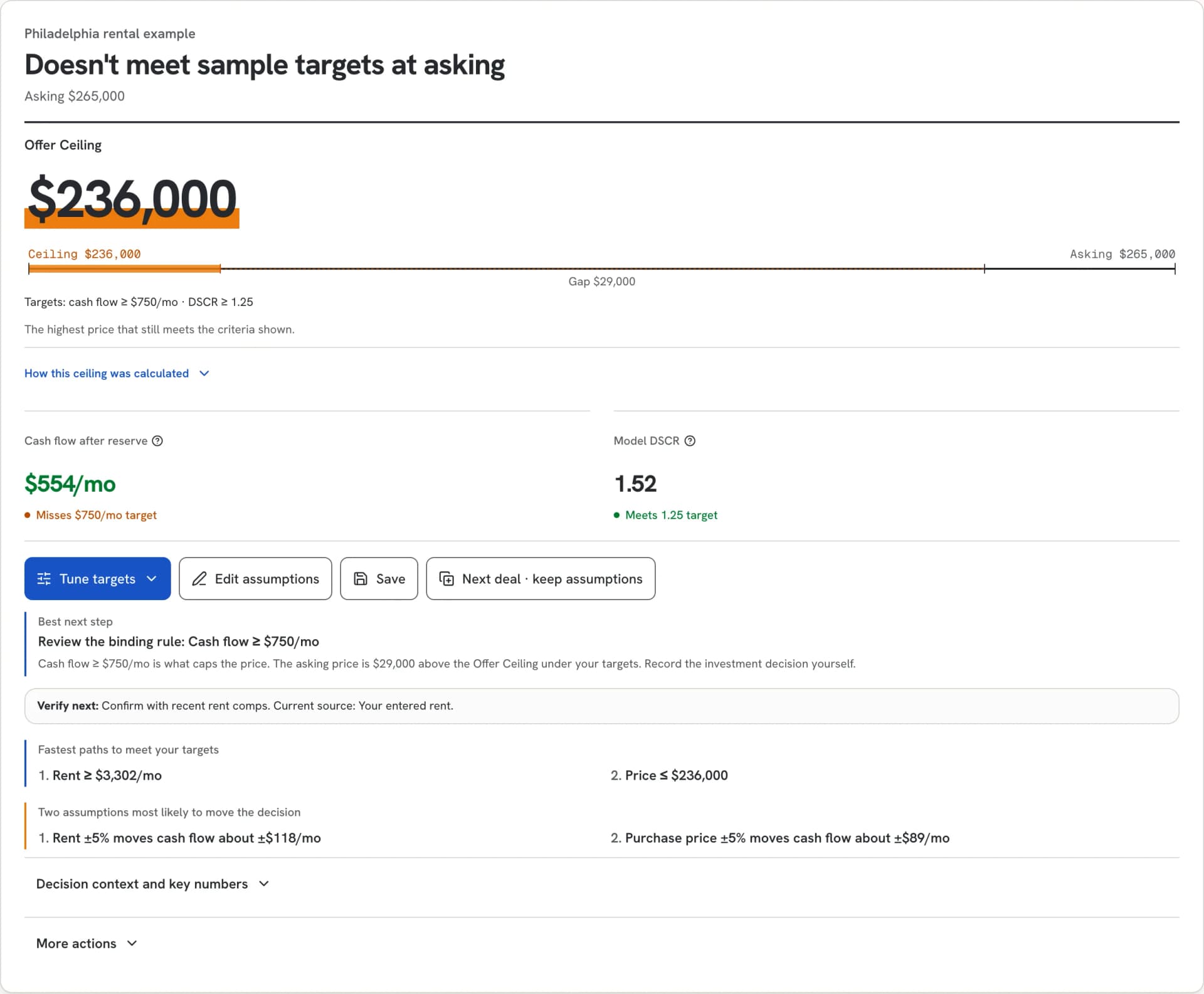
Avail publishes a rental property calculator; its page says it calculates cap rate, cash-on-cash return, debt coverage ratio, IRR, and gross rent multiplier from the inputs you enter. TrueCap starts from labeled values (an editable HUD rent benchmark and the FRED rate) and adds a Deal score. Your first complete decision also shows the Offer Ceiling, the highest price that still meets your targets; Pro keeps it on every deal, with the sensitivity grid and a 10-year projection.
Avail is owned by Realtor.com — does that matter?
Functionally not much: the operator of Realtor.com acquired Avail in December 2020 and the product has continued. It does mean Avail listings are syndicated to Realtor.com. TrueCap is independent, with no listing-side incentive (we don't benefit from any deal happening, only from giving you a good number on it).
On price, plainly
Tools in this space run from free to well above TrueCap — check Avail's live pricing for their current number. What TrueCap's price buys is the decision layer, not more calculation: an Offer Ceiling for your targets, Buy Box fit with reasons, the downside stress test, and assumptions that are source-labeled instead of silently defaulted. Whether that workflow justifies the price depends on your volume, verification process, and existing tools.
Screening listings for investor clients? TrueCap for agents keeps a client roster and screens each deal against the Buy Box of the client you assign it to.
Underwrite the next deal — free.
TrueCap free covers cap rate, CoC, DSCR, monthly cash flow, and plain read-only share links. Your first complete decision also includes the Offer Ceiling. Pro adds 10-year cash-flow and equity projections, sensitivity, Offer Ceiling, co-branding, and included PDFs. New one-time PDF checkout is temporarily unavailable. No card to start.
About TrueCap
TrueCap is built by one person, a rental investor in Philadelphia. It started as the tool he wanted for his own underwriting — a way to get from an address to a source-labeled first-pass answer — and it's still how he runs the deals he considers.