
TrueCap vs Zillow Rent Estimate: why the Rent Zestimate isn't enough for investors
By TrueCap · built by a Philadelphia rental investor
Zillow's Rent Zestimate is a fast, property-specific starting estimate. It is still only one input: acquisition underwriting also needs verified expenses, financing terms, vacancy, reserves, and sensitivity testing. Here's how the two tools differ.
Free analyzer: no card or signup
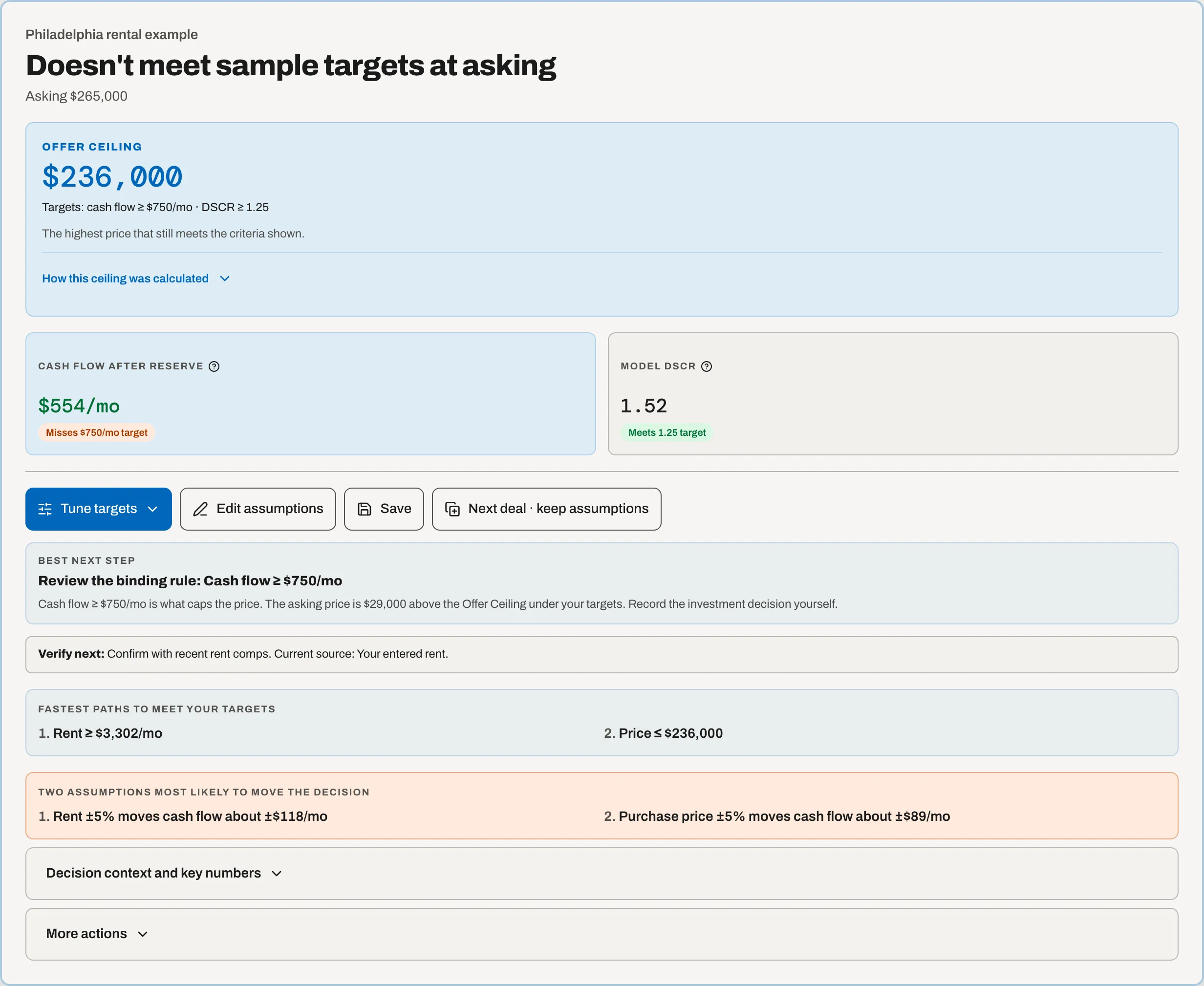
Where a Rent Zestimate stops short of an underwrite
Zillow says its Rent Zestimate uses public data and similar local rental listings. That can be useful for orientation, but an acquisition decision still needs additional evidence:
- An estimate is not an executed lease. Verify the subject property's achievable rent with current comps, lease records, or a local professional.
- Zillow names its own limits. It says special features, location and market conditions may not be taken into account.
- Rent is only one assumption. Taxes, insurance, financing, vacancy, management, maintenance, and capital reserves can change the decision.
HUD Fair Market Rent, which TrueCap uses as an editable rent benchmark, estimates gross rent for standard-quality units at the 40th percentile within HUD-defined areas. It is not a property-specific rent opinion, appraisal, or lender approval input; replace it when you have stronger local evidence.
TL;DR
Use TrueCap if
- You're an investor underwriting a deal — the rent estimate is going into a real money decision.
- You want an editable HUD rent benchmark inside a full underwriting workflow.
- You need the rent number + everything else (cap rate, DSCR, cash flow, projection).
- You want complete modeled economics, not just "here's the rent."
Use Zillow if
- You're just casually browsing for inspiration.
- You're a tenant trying to gauge what rent in an area looks like.
- You want a quick property-specific estimate to compare with other rent evidence.
Feature-by-feature
| Feature | TrueCap | Zillow Rent Estimate |
|---|---|---|
| Rent estimate source | Editable HUD rent benchmark; add property-specific rent evidence | Property-specific estimate using public data and similar local listings |
| Estimate accuracy | Depends on the benchmark and property-specific evidence you enter | Zillow says special features, location and market conditions may not be taken into account |
| Useful for investor underwriting | Yes — rent remains editable inside the full expense and financing model | Useful starting point; verify with current local evidence |
| Full deal underwrite | Free core metrics; Pro adds 10-year projections, sensitivity and the Offer Ceiling | The Rent Zestimate is a rent estimate: one input to an underwrite |
| Property tax input | Manual local bill or reviewed rate; blank inputs use a disclosed generic default | Not part of the Rent Zestimate; verify the post-sale tax basis with the county |
| Cap rate / CoC / DSCR computation | Computed live with editable assumptions | Not part of the Rent Zestimate |
| Listings, photos and tours | Not in scope: TrueCap analyzes an address you bring | See Zillow for listings, photos and tours |
| Save deals + portfolio rollup | Free saves up to 5 deals; Pro adds unlimited saves, portfolio rollup + comparison | Not part of the Rent Zestimate |
| Shareable analysis URL | Free — read-only public URL for the available analysis | Not part of the Rent Zestimate |
| Underwriting context | Core economics and the Deal score free; Buy Box fit on your first decision, then with Pro | A rent estimate; the underwrite happens elsewhere |
Source definitions: Zillow describes Rent Zestimate as a starting point based on public data and similar local listings; HUD defines FMR as an area-level gross-rent benchmark. Review Zillow's official explanation and HUD's official FMR documentation.
A rent estimate is just the first input — the decision lives downstream. Push your number through our free deal analyzer to turn it into a cap rate and a cash-on-cash return. Our guide on underwriting a rental in 60 seconds shows the whole path from address to a reviewed underwrite.
Common questions about TrueCap vs Zillow Rent Estimate
Quick answers to the questions investors comparison-shopping these tools actually ask.
Is the Zillow Rent Estimate accurate for investors?
Zillow describes its Rent Zestimate as a starting point based on public data and similar local listings, and says special features, location and market conditions may not be taken into account. For underwriting, compare it with current rent comps, lease evidence, and local professional input, then stress-test a reasonable range.
What rent data does TrueCap use instead of Zillow?
TrueCap starts from an editable HUD rent benchmark for the relevant bedroom count: ZIP-level when available, otherwise the HUD Fair Market Rent area; when an address has no county match, a statewide HUD figure, labeled as such. HUD publishes FMRs for housing-program administration; they are not property-specific rent opinions or lender approvals. Replace the value when you have stronger local evidence.
Can I check rent on a specific Zillow listing in TrueCap?
Yes — paste the property address into TrueCap and you get an editable HUD rent benchmark for that bedroom count. The rent field is editable, so if you see a Rent Zestimate you trust more for that specific listing, type it in and the full underwrite updates in real time.
Does TrueCap give a more accurate rent estimate than Zillow?
Neither source is guaranteed to be more accurate for every property. Zillow offers a property-specific starting estimate; TrueCap places an editable HUD rent benchmark inside a full expense and financing model. Compare both with current local evidence and use a sensitivity range before deciding.
How does TrueCap turn a rent estimate into an underwrite?
TrueCap takes rent, expenses, financing, and tax assumptions and runs cap rate, cash-on-cash, DSCR, and monthly cash flow. The free analyzer also includes a Deal score (0–100) with factor breakdown. Buy Box fit against your targets is free on your first decision, then with Pro. The Rent Zestimate is a rent number; the rest of the underwrite happens downstream of it.
On price, plainly
Tools in this space run from free to well above TrueCap — check Zillow Rent Estimate's live pricing for their current number. What TrueCap's price buys is the decision layer, not more calculation: an Offer Ceiling for your targets, Buy Box fit with reasons, the downside stress test, and assumptions that are source-labeled instead of silently defaulted. Whether that workflow justifies the price depends on your volume, verification process, and existing tools.
Screening listings for investor clients? TrueCap for agents keeps a client roster and screens each deal against the Buy Box of the client you assign it to.
Start with a rent benchmark, then underwrite the deal.
Paste an address. TrueCap starts with an editable HUD rent benchmark and a mortgage-rate benchmark; enter a local property-tax bill or reviewed rate manually. Replace those starting assumptions with property-specific evidence before relying on the result.
About TrueCap
TrueCap is built by one person, a rental investor in Philadelphia. It started as the tool he wanted for his own underwriting — a way to get from an address to a source-labeled first-pass answer — and it's still how he runs the deals he considers.