
TrueCap vs Rentometer: different tools, different jobs
By TrueCap · built by a Philadelphia rental investor
Rentometer starts from rent: an estimate for an address built on nearby rental comps, plus a Deal Worksheet on its Pro plan that turns that rent into cash flow and cash-on-cash return. TrueCap starts from the purchase decision: first-year rental economics from editable assumptions, with rent as one input you replace. Here's where each one fits.
Free analyzer: no card or signup
TL;DR
Pick TrueCap if
- You want cap rate, cash-on-cash, DSCR and cash flow on every deal, with a 10-year projection on Pro.
- You want to decide whether to buy, not just what rent to charge.
- You want operating expenses, mortgage debt service, and an editable property-tax input included.
- You want cash flow and returns for each property, with Buy Box fit on your first decision and then with Pro.
- You want unlimited free analyses.
Use Rentometer if
- You need rent comps for an address: a listing or a client report.
- You're a property manager checking comp prices for a rent renewal.
- You need deeper comp data beyond HUD's Fair Market Rent.
- You want a quick second-opinion rent estimate alongside your other tools.
- You want rent comps and a deal worksheet in one subscription (Rentometer Pro).
The two can work together: take a rent comp from Rentometer and type it into TrueCap's rent field for the full deal underwrite.
Feature-by-feature
| Feature | TrueCap | Rentometer |
|---|---|---|
| Rent estimate from address | Editable HUD rent benchmark; optional rent-comp lookup | Comp-driven rent estimate (their core product) |
| Comp data access | One free sale/rent comp lookup; Pro includes up to 50 per month | Rental-comp product with plan-specific limits |
| Full deal underwrite | Free core metrics; Pro adds 10-year projections | Deal Worksheet on Rentometer Pro: cash flow, cash-on-cash and gross yield |
| Operating expense modeling | Editable tax, insurance, maintenance, management, and reserve inputs | Editable operating expenses, taxes and insurance in the Pro Deal Worksheet |
| Mortgage / financing analysis | Full mortgage model with an editable FRED rate benchmark | Editable financing terms in the Pro Deal Worksheet |
| Cap rate / CoC / DSCR | All three computed live | Cash-on-cash and gross yield in the Pro Deal Worksheet; its worksheet page does not name cap rate or DSCR |
| 10-year projection | Pro — rent + expense + appreciation compounding | Not described on Rentometer's Deal Worksheet page |
| Free use limit | Unlimited core analyses; comp-lookup limits apply | Free account; paid plans from $59 a year (as of October 2026) |
| Underwriting context | Core economics and the Deal score free; Buy Box fit on your first decision, then with Pro | Rent estimates and comps on every plan; the Deal Worksheet on Pro |
| PDF report | Included with Pro | PDF of rent comp data |
| Use case | Full investor underwriting workflow | Rent estimates and comps, with a deal worksheet on Pro |
| Pricing — paid tier | See TrueCap's live pricing page | Basic $59 a year; Essential $16 a month or $96 a year; Pro $29 a month or $199 a year (as of October 2026) |
Rentometer details checked in October 2026 against Rentometer's pricing page and its Deal Worksheet page. Prices are list prices before promo codes; see Rentometer for current plans.
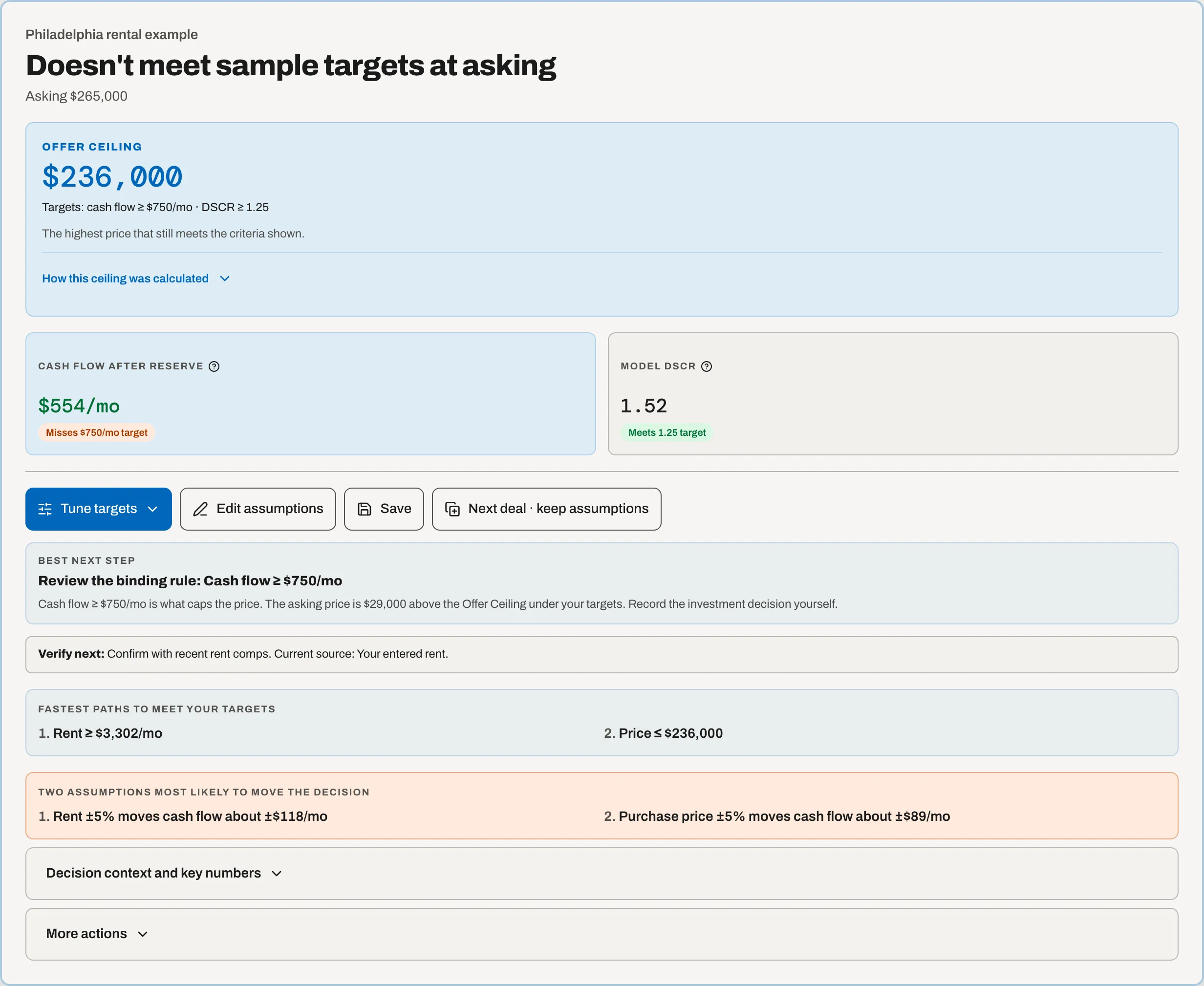
A rent number only matters once it flows into returns. Drop your Rentometer comp into our free deal analyzer to see what that rent actually earns as cap rate and cash-on-cash return. For the full income statement behind those metrics, our rental property pro forma guide lays out every line.
Common questions about TrueCap vs Rentometer
Quick answers to the questions investors comparison-shopping these tools actually ask.
Is TrueCap an alternative to Rentometer?
They overlap in part. Rentometer specializes in rent estimates built from recent nearby rental comps, and its Pro plan adds a Deal Worksheet for cash flow and cash-on-cash return. TrueCap is a full underwriting calculator that starts from an editable HUD rent benchmark and runs the downstream math (cap rate, CoC, DSCR, cash flow). If you want a rent estimate from nearby comps, Rentometer can complement the underwrite. Verify either source with property-specific evidence.
Does TrueCap give me a rent estimate like Rentometer?
Not by default. TrueCap pre-fills rent using an editable HUD rent benchmark for the relevant bedroom count: ZIP-level when available, otherwise the HUD Fair Market Rent area; when an address has no county match, a statewide HUD figure, labeled as such. It is a housing-program benchmark, not a property-specific rent opinion or lender approval input. The optional comps lookup (one free lookup; Pro includes up to 50 per month) adds a rent estimate from nearby properties. Rentometer's comp-based estimates can provide a separate source to evaluate.
What's the difference between HUD FMR and Rentometer?
HUD Fair Market Rent is a government-published estimate of 40th-percentile gross rent for standard-quality units within HUD-defined areas. Rentometer builds its estimate from recent nearby rental comps and reports an average and a median. They answer different questions, and neither replaces subject-property lease evidence or local diligence.
Can I use Rentometer's rent in TrueCap?
Yes — every input in TrueCap is editable. If you trust Rentometer's comp for a specific neighborhood, type that number into the rent field and the rest of the analysis updates instantly. TrueCap pre-fills the HUD figure as a starting point, not a hard requirement.
Do I need both Rentometer and TrueCap?
It depends on the evidence available for the property. TrueCap provides the underwriting model and an editable HUD rent benchmark; Rentometer can add comp-based rent context. Use the sources that fit the property, verify them independently, and sensitivity-test a reasonable rent range.
On price, plainly
Tools in this space run from free to well above TrueCap — check Rentometer's live pricing for their current number. What TrueCap's price buys is the decision layer, not more calculation: an Offer Ceiling for your targets, Buy Box fit with reasons, the downside stress test, and assumptions that are source-labeled instead of silently defaulted. Whether that workflow justifies the price depends on your volume, verification process, and existing tools.
Screening listings for investor clients? TrueCap for agents keeps a client roster and screens each deal against the Buy Box of the client you assign it to.
Get the core underwrite free.
Bring a rent number from Rentometer, a lease or your own comps. TrueCap runs the rest of the underwrite: expenses, financing, cap rate, cash-on-cash and DSCR. Try a deal.
About TrueCap
TrueCap is built by one person, a rental investor in Philadelphia. It started as the tool he wanted for his own underwriting — a way to get from an address to a source-labeled first-pass answer — and it's still how he runs the deals he considers.