
TrueCap vs Fundrise: direct ownership vs fund shares
By TrueCap · built by a Philadelphia rental investor
Fundrise is an investment platform: you buy shares of funds it manages, which hold private real estate, private credit and venture capital. TrueCap is the underwriting calculator for investors buying rental properties directly with their own financing. The investing models are different, and if you are deciding between active and passive real estate you may be weighing both.
Free analyzer: no card or signup
TL;DR
Use TrueCap when
- You want direct control of the property and the financing.
- You want direct-property control and will verify depreciation, interest, and any 1031 eligibility with tax professionals.
- You have the capital for a down payment and want to deploy it in one property at a time.
- You're willing to do the underwriting + management work yourself.
Use Fundrise when
- You want passive real estate exposure with zero work.
- You want diversification across asset classes (real estate, private credit and venture capital).
- You want to start with as little as $10 rather than a down payment.
Feature-by-feature
Side-by-side on every dimension that matters for a comparison-shopping investor.
| Feature | TrueCap | Fundrise |
|---|---|---|
| Ownership model | Direct ownership of whole property | Shares of funds that Fundrise manages |
| Cap rate / CoC / DSCR analysis | Yes — full engine, free tier | Not applicable: you buy fund shares, not a single property |
| 10-year projection | Pro — per-property rent + expense + appreciation | Fundrise publishes its clients' past returns on its own site |
| Deal score (0–100) | Free — 0–100 score with factor breakdown | Not applicable |
| Minimum to start | A down payment on a whole property | $10 |
| Time commitment | Active — you source, underwrite, close, manage (or hire) | Passive: you choose a portfolio strategy and Fundrise manages the funds |
| Liquidity | Low — sale takes months | Quarterly redemptions, subject to limitations |
| Diversification | One property at a time | Across the assets its funds hold: real estate, private credit and venture capital |
| Control over property choice | Total | You choose a plan or a fund; Fundrise selects the assets |
| Ownership tax treatment | Direct-property rules may allow depreciation, interest, or 1031; TrueCap does not determine eligibility | See Fundrise's own tax documents |
| Cash flow model | You design — fixed-rate mortgage, your CF goes to you | See Fundrise's site for how its funds pay distributions |
| Pricing / fees | Free core; paid Pro — see live pricing | 0.15% annual advisory fee, plus a 0.85% annual asset management fee paid by the funds in its standard portfolios |
| Free tier (for analysis) | Yes — core cap rate, CoC, DSCR, and cash flow | Not applicable |
Fundrise's minimum, fees and redemption terms were checked against its how-it-works page in October 2026. This page repeats no return figure: for past returns see Fundrise's client returns page, and for tax documents and current offerings see fundrise.com.
When to use which (or both)
- If you want full control → direct ownership. TrueCap helps you underwrite; you arrange financing + take title.
- If you want passive exposure with low minimums → Fundrise. Choose a portfolio strategy, set up recurring investments if you want them, and Fundrise manages the funds.
- If you want both → split the portfolio. TrueCap helps with the direct side.
Curious what underwriting a direct rental actually involves? Start with the free real estate calculators, or run a real address through the full TrueCap analyzer for cap rate, DSCR, and cash flow. Our guide on 60-second underwriting walks through the workflow end-to-end.
Common questions about TrueCap vs Fundrise
Quick answers to the questions investors comparison-shopping these tools actually ask.
Is TrueCap a Fundrise alternative?
Not really — completely different investing models. Fundrise offers shares of funds it manages, which hold private real estate, private credit and venture capital (passive). TrueCap is the underwriting calculator for investors buying rentals directly (active). The decision isn't which to use — it's which investing model fits you.
Fundrise vs Arrived — which one?
They work at different levels. Fundrise offers funds it manages across real estate, private credit and venture capital, and says you can start with as little as $10. On Arrived you buy shares of individual rental homes or of its funds, with a $100 minimum investment. TrueCap does not rank them: see Fundrise's how-it-works page and arrived.com for current offerings, fees and risks.
Is Fundrise really passive?
Yes, in the sense that Fundrise manages the funds and the assets in them. You choose a portfolio strategy or a fund and contribute capital. The tradeoff is that you do not choose individual properties, and fees apply: Fundrise lists a 0.15% annual advisory fee, says the funds in its standard portfolios pay a 0.85% annual asset management fee, and says its offering circulars describe all fees. See Fundrise's how-it-works page for the current terms.
Why would I buy a rental directly when I could just put money in Fundrise?
Two reasons: control (you pick the property + financing) and cash-flow control. Tradeoff: real work or paying a PM.
Can I compare Fundrise's returns with a TrueCap analysis?
Not directly. TrueCap models per-property metrics (cap rate, DSCR, cash flow), not fund returns. A fund's return and a direct rental's cash-on-cash return are different measures and are not directly comparable. Fundrise publishes its clients' past returns on its client returns page; TrueCap repeats no figure from it. Evaluate each on its own terms.
On price, plainly
Tools in this space run from free to well above TrueCap — check Fundrise's live pricing for their current number. What TrueCap's price buys is the decision layer, not more calculation: an Offer Ceiling for your targets, Buy Box fit with reasons, the downside stress test, and assumptions that are source-labeled instead of silently defaulted. Whether that workflow justifies the price depends on your volume, verification process, and existing tools.
Screening listings for investor clients? TrueCap for agents keeps a client roster and screens each deal against the Buy Box of the client you assign it to.
Underwrite the next deal — free.
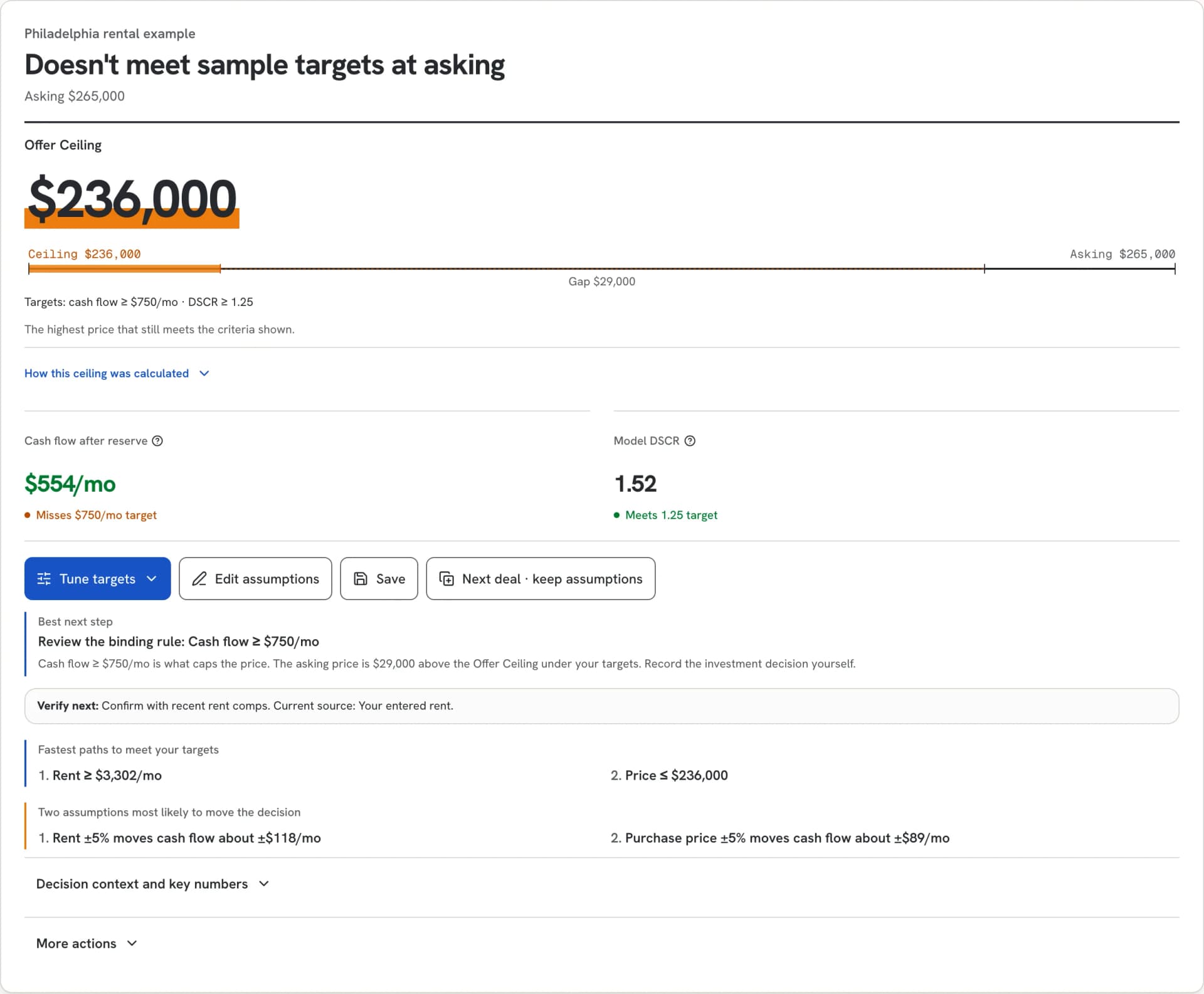
TrueCap free covers cap rate, CoC, DSCR, and monthly cash flow. Your first complete decision also includes the Offer Ceiling. Pro adds 10-year cash-flow and equity projections, sensitivity, the Offer Ceiling, co-branded share links and PDF reports; see live pricing for current terms. No card to start.
About TrueCap
TrueCap is built by one person, a rental investor in Philadelphia. It started as the tool he wanted for his own underwriting — a way to get from an address to a source-labeled first-pass answer — and it's still how he runs the deals he considers.