
TrueCap vs BiggerPockets for House Hacking: which calculator handles owner-occupant deals correctly?
By TrueCap · built by a Philadelphia rental investor
Both run house-hack underwriting. This is the house-hacker cut: which one models owner-occupant unit usage cleanly, handles FHA 3.5%-down financing, and shows your net monthly cost: the number that decides whether the deal beats just renting an apartment.
No card · Free analyzer covers house-hack underwriting
TL;DR for house hackers
TrueCap has a dedicated house-hack setup: the explicit "owner-occupant" property type counts your unit at $0 rent, so the cash-flow line is your net monthly cost after reserves, and every rent and expense input stays editable. BiggerPockets' rental calculator form has one gross income field and no owner-occupied setting, so you adjust the rent for your own unit yourself. TrueCap has a free core owner-occupant workflow; BiggerPockets' calculator form says results unlock with Pro or a 7-day free trial. Compare both live pricing pages.
House-hack feature-by-feature
Where each tool wins on the house-hack-specific workflow.
| Feature | TrueCap | BiggerPockets |
|---|---|---|
| Owner-occupant property type | Yes — explicit 'owner-occupant' property type with per-unit setup | Standard rental form with no owner-occupied setting; you adjust it yourself |
| Per-unit rent + status modeling | Yes — mark which unit YOU live in; other units' rent counted | One gross monthly income field with an optional breakdown; you leave out your own unit's rent |
| Your unit in the cash-flow line | In House Hack mode your unit counts at $0 rent, so the cash-flow line is your net monthly cost after reserves | Read it from the cash-flow line after leaving out your own unit's rent |
| FHA financing assumptions (3.5% down) | Yes — configurable down payment goes as low as 3.5% | Yes — configurable |
| Cap rate framing | Standard property-level cap rate; no full-vs-rental-only toggle | Standard cap rate; adjust inputs for each scenario |
| Starting values (rent/rate/tax) | HUD rent benchmark per unit + FRED rate + manual local property tax | Entered by hand in the rental form; a separate Rent Estimator calculator is listed |
| DSCR screening ratio | Yes — screening output, not a lender approval model | Not listed on its public calculator page |
| Post-move-out scenario | Save a separate fully rented scenario; no move-out-year switch | Run a separate report for the fully rented case |
| Sensitivity grid (vacancy on rental units) | Pro — rent ±10%, vacancy ±5pp on rental units only | Manual re-runs |
| Mobile UX at the showing | PWA installable | Web calculator form; BiggerPockets also has an iPhone app |
| Free tier covers house hacking | Yes — core owner-occupant underwriting on free tier | Its calculator form says results unlock with Pro or a 7-day free trial; a sign-up prompt on its site mentions 5 free calculator reports, and its house hacking page offers a free House Hack vs. Rent vs. Buy calculator download with sign-up |
| Pricing | Free core; paid Pro — see live pricing | Calculator bundled with Pro — see live pricing |
BiggerPockets details checked against its rental calculator page, its public calculator form, its house hacking page, and its membership page in October 2026. See BiggerPockets' official rental calculator page for current details.
New to running an owner-occupant deal? Our house hack underwriting guide walks through counting only the rental units' income. To pressure-test the numbers on your own deal, our free deal analyzer returns cap rate and cash-on-cash return for the same owner-occupant setup.
Common questions about TrueCap vs BiggerPockets
Quick answers to the questions investors comparison-shopping these tools actually ask.
Which is better for house hackers — TrueCap or BiggerPockets?
TrueCap provides a more explicit house-hack setup. The main difference is the explicit "owner-occupant" property type — you mark which unit you'll live in, and TrueCap automatically excludes that unit's "rent" from the income side of the underwriting (because you're paying yourself, effectively). BiggerPockets' rental calculator form has no owner-occupied setting, so you leave your own unit out of the income yourself. BiggerPockets also offers a separate House Hack vs. Rent vs. Buy calculator as a free download with sign-up. Both work; TrueCap is just less manual setup for the house-hack workflow.
Does TrueCap handle FHA 3.5%-down house hacks?
Yes — TrueCap's down payment field is configurable. Set it to 3.5% for FHA, 5% for conventional owner-occupant, 10-15% for bigger deals where you want a lower PMI burden. PITI and DSCR recalculate automatically. Enter the lender's annual FHA mortgage insurance premium in the dedicated PMI / MIP field and select the loan-life option when it applies. If an upfront premium is not financed, include that cash amount in closing costs.
What is my net monthly cost in a house hack, and why does it matter?
When you house-hack, your monthly housing cost isn't the full PITI: the rent from the other units offsets it. In House Hack mode TrueCap counts your unit at $0 rent, so the monthly cash-flow line is your net monthly cost after the other units' rent, operating expenses, and reserves. Compare that number with what you would pay to rent a similar apartment.
Does the cap rate apply differently to a house hack?
Cap rate remains property-level NOI divided by purchase price. TrueCap does not provide a dedicated full-property versus rental-units-only cap-rate toggle. Model the current owner-occupied case, then save a separate fully rented scenario to review the post-move-out case.
Is BiggerPockets Pro worth it for the calculator alone?
It depends on which membership benefits you use. BiggerPockets' calculator form says results unlock with Pro or a 7-day free trial, and its membership includes benefits beyond the calculator. TrueCap has free core owner-occupant underwriting and paid Pro analysis tools. Compare both live pricing pages and the features you actually need.
What changes when I model the post-move-out scenario?
When you move out of the owner-occupied unit and rent it to a third tenant, you're back to a standard rental underwrite — all units producing rent, your housing cost moves elsewhere. TrueCap does not have a dedicated "year you move out" switch. Save a separate fully rented multi-family scenario and compare it with the current owner-occupied case. Pro can compare saved deals side-by-side and add 10-year projections to each.
On price, plainly
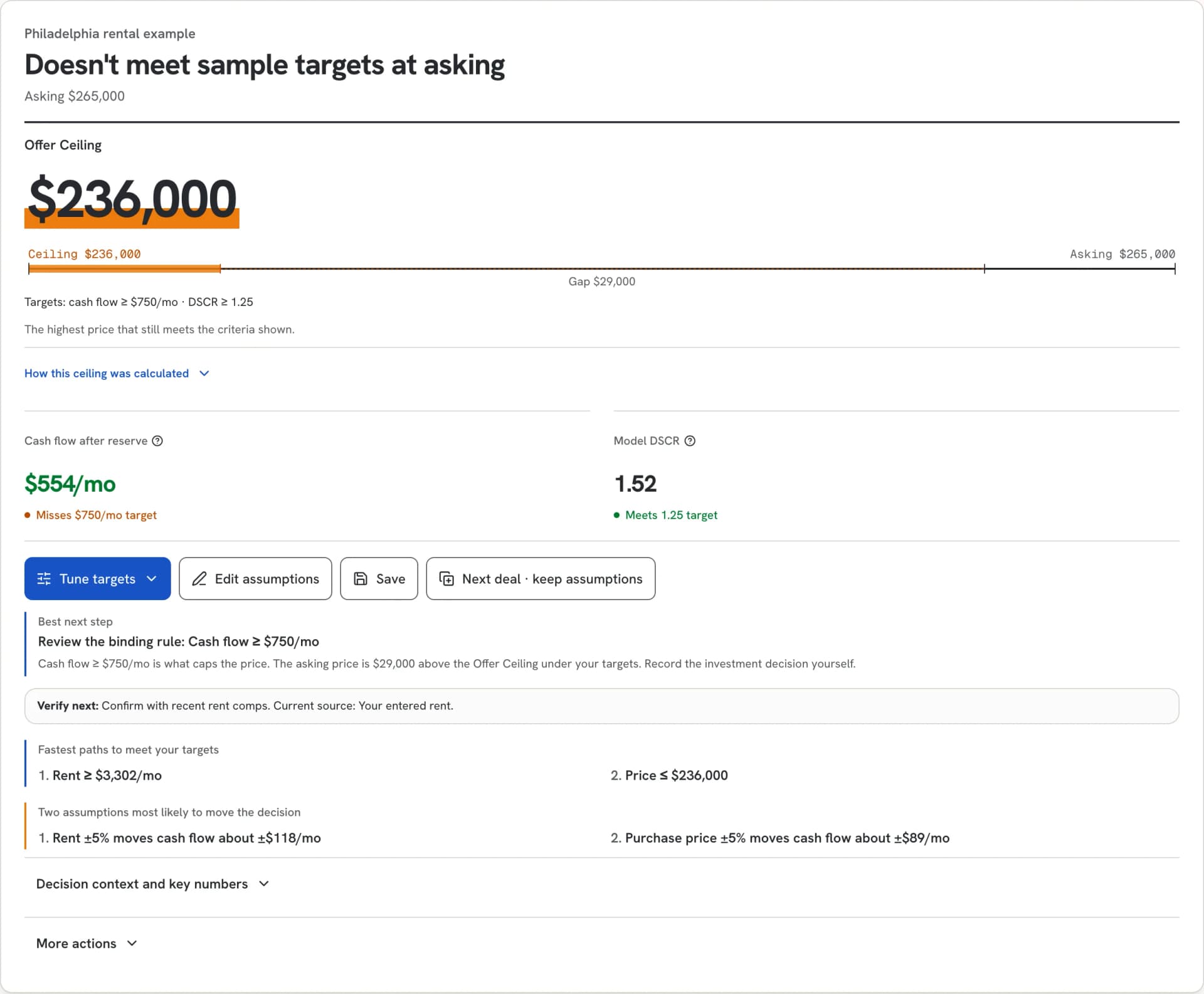
Tools in this space run from free to well above TrueCap — check BiggerPockets's live pricing for their current number. What TrueCap's price buys is the decision layer, not more calculation: an Offer Ceiling for your targets, Buy Box fit with reasons, the downside stress test, and assumptions that are source-labeled instead of silently defaulted. Whether that workflow justifies the price depends on your volume, verification process, and existing tools.
Screening listings for investor clients? TrueCap for agents keeps a client roster and screens each deal against the Buy Box of the client you assign it to.
Underwrite your first house hack — free.
TrueCap's free tier covers owner-occupant property types, per-unit rent + status, FHA financing, and your net monthly cost in House Hack mode. Pro adds a 10-year cash-flow and equity planning view, sensitivity, Offer Ceiling, and saved-deal comparison. Model post-move-out as a separate fully rented scenario; see live pricing and check trial eligibility.
About TrueCap
TrueCap is built by one person, a rental investor in Philadelphia. It started as the tool he wanted for his own underwriting — a way to get from an address to a source-labeled first-pass answer — and it's still how he runs the deals he considers.