
TrueCap vs Reonomy: residential underwriting vs commercial intelligence
By TrueCap · built by a Philadelphia rental investor
Reonomy is commercial real estate intelligence — property data, owner contact info, debt + transaction history and occupant data across 53M+ commercial properties. Reonomy lists brokers, investors, lenders, developers and appraisers among its users. TrueCap is a residential rental underwriting calculator — single-family, small multifamily, owner-occupant. Different asset classes, different jobs.
Free analyzer: no card or signup
TL;DR
Use TrueCap when
- You underwrite residential rentals (SFR, small multifamily, owner-occupant).
- You want cap rate, CoC, DSCR, cash flow on specific addresses.
- You're not pursuing commercial deals.
- You want a free tier for the core analysis.
Use Reonomy when
- You source commercial real estate deals.
- You need CRE owner contact info for outreach.
- You research CRE debt + transaction history for due diligence.
- You're a broker, investor, or lender working in CRE.
Feature-by-feature
Side-by-side on every dimension that matters for a comparison-shopping investor.
| Feature | TrueCap | Reonomy |
|---|---|---|
| Primary asset class | Residential (SFR, small multifamily, owner-occupant) | Commercial real estate: 53M+ US commercial properties |
| Primary use | Per-deal underwriting (model cash flow and returns) | CRE property + owner intelligence (find + research) |
| Cap rate / CoC / DSCR analysis | Yes — full engine for residential | Not on Reonomy's published feature list; it is a property and ownership data platform |
| 10-year projection | Pro — rent + expense + appreciation | Not on Reonomy's published feature list |
| Starting values (rent/rate/tax) | HUD rent + FRED rate + manual local property tax | Commercial property, transaction and ownership records |
| Commercial property data | No — residential focus | Yes: 53M+ US commercial properties |
| Owner contact info | No | Yes — phone + email for CRE owners |
| Debt + transaction history | No | Yes — mortgage + sale history |
| Tenant rosters (CRE) | No | Yes: occupant data, including a tenant's US locations |
| Free tier | Yes: core residential underwriting | No free tier (free trial on request) |
| Pricing | Free core; paid Pro — see live pricing | Self-serve monthly and annual plans; reonomy.com lists a starting price of $400 a month on an annual subscription (as of October 2026). Data feeds and API by quote |
Reonomy details checked in October 2026 against reonomy.com and Reonomy's pricing page. See Reonomy for current plans.
Where TrueCap and Reonomy fit together
- If you do residential and commercial. TrueCap for residential underwriting; Reonomy for CRE prospecting + due diligence.
- Purely residential investors. Reonomy's data set is commercial property, so it is not where a house search starts. TrueCap handles the underwriting.
- Purely commercial investors. Reonomy plus a commercial underwriting model of your own. TrueCap isn't built for CRE.
Only need the residential underwriting? How to calculate cap rate covers the formula, and what is a good cap rate frames the result against real market ranges. For the full residential underwrite — cap rate, cash-on-cash, DSCR and a 10-year projection — start with the TrueCap analyzer.
Common questions about TrueCap vs Reonomy
Quick answers to the questions investors comparison-shopping these tools actually ask.
Is TrueCap a Reonomy alternative?
No — different asset classes. Reonomy is commercial real estate intelligence. TrueCap is residential rental underwriting. The two don't overlap meaningfully.
Reonomy vs PropStream — which one?
Start from the property type. Reonomy describes itself as a commercial property data platform covering 53M+ US commercial properties. PropStream is a separate product; check PropStream's own site for its coverage and plans before choosing.
Is Reonomy enterprise-only?
No. Reonomy sells monthly and annual subscriptions online, describes the monthly plan as best for individuals, and offers a free trial on request. Its homepage lists a starting price of $400 a month on an annual subscription (as of October 2026). Bulk data feeds and the API are priced by quote. Its data set is commercial property.
Does Reonomy do underwriting?
Reonomy describes itself as a commercial property data platform: property details, ownership, contacts and transaction history. Its published feature list names no underwriting model, so you use that data as input to your own.
Should solo investors care about Reonomy?
Only if you're moving into commercial real estate. Reonomy's data set is commercial property, and its published starting price is $400 a month on an annual subscription (as of October 2026).
On price, plainly
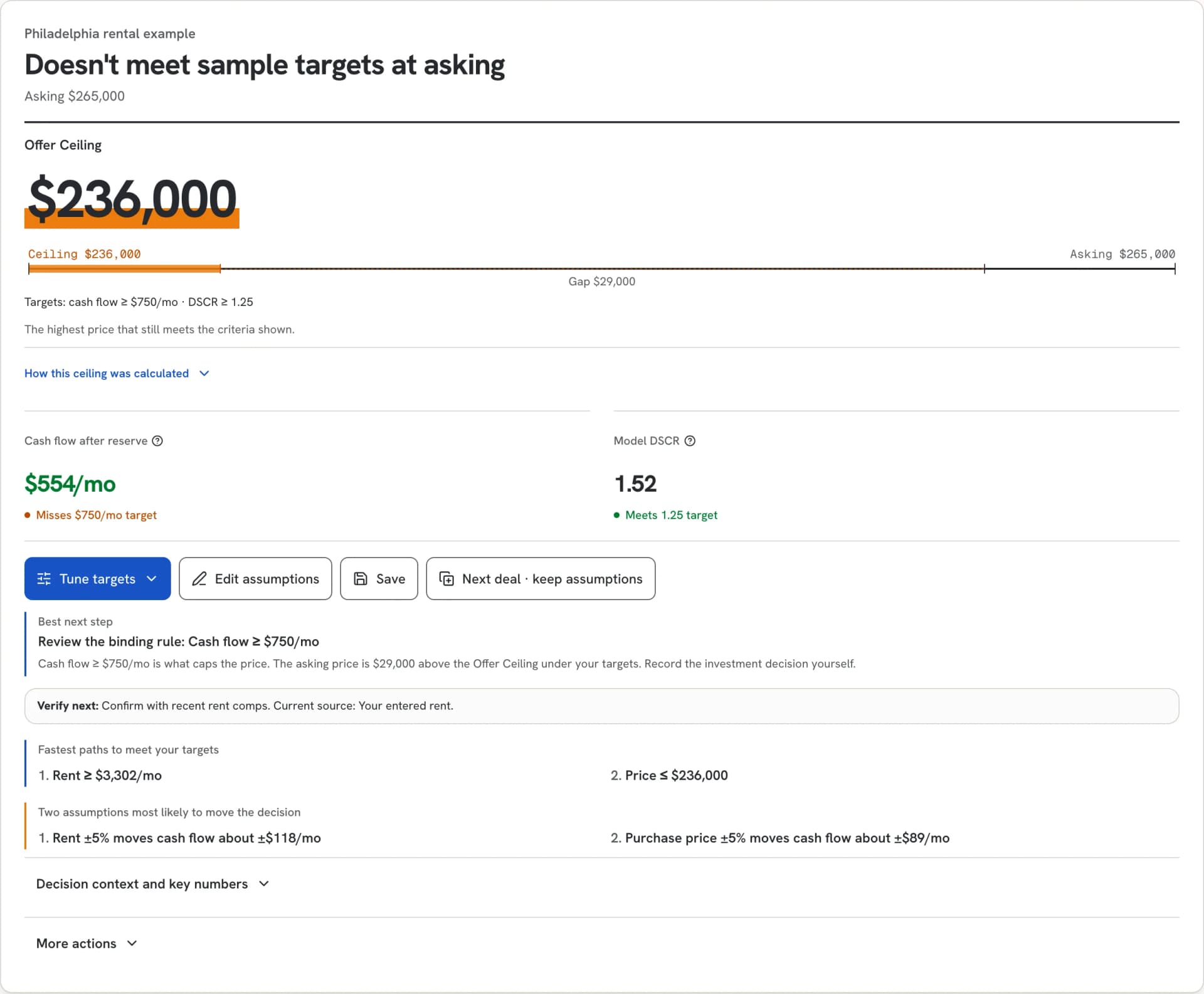
Tools in this space run from free to well above TrueCap — check Reonomy's live pricing for their current number. What TrueCap's price buys is the decision layer, not more calculation: an Offer Ceiling for your targets, Buy Box fit with reasons, the downside stress test, and assumptions that are source-labeled instead of silently defaulted. Whether that workflow justifies the price depends on your volume, verification process, and existing tools.
Screening listings for investor clients? TrueCap for agents keeps a client roster and screens each deal against the Buy Box of the client you assign it to.
Underwrite the next deal — free.
TrueCap free covers cap rate, CoC, DSCR, and monthly cash flow. Your first complete decision also includes the Offer Ceiling. Pro adds 10-year cash-flow and equity projections, sensitivity, the Offer Ceiling, co-branded share links and PDF reports; see live pricing for current terms. No card to start.
About TrueCap
TrueCap is built by one person, a rental investor in Philadelphia. It started as the tool he wanted for his own underwriting — a way to get from an address to a source-labeled first-pass answer — and it's still how he runs the deals he considers.